Flight Deck Eye Tracking
Improve scan flows, enhance situational awareness, reveal hidden habits.
Uses lightweight eye-tracking glasses (wearable under headsets)
Methodology rooted in cognitive factors and human performance research
Get a post-flight debrief with video playback of your exact gaze patterns
Book a SessionPerformance Analysis
How It Works:
Bring your CFI: I meet with both you and your flight instructor.
Pre-Flight Briefing: We discuss your goals (e.g., instrument scan, landing flare, checklist flows).
Data Capture Flight: You fly your mission wearing the eye-tracking glasses. They are lightweight and fit comfortably under your headset, recording your visual attention at 120Hz alongside wide-angle HD video.
Cloud Analytics: After we land, your data is uploaded to our secure analytics engine for video stabilization and fixation calculations. I personally process your data to identify hidden perceptual errors, scan breakdowns, and cognitive workload.
Your Performance Report: Within 48 hours, you will receive a secure link to your customized digital report. This includes an annotated video playback of your flight with the eye-tracking overlay, which you can review with your CFI.
Who Is This For?: Student pilots struggling with scans, instrument students, CFIs wanting to validate their teaching, or seasoned pilots looking to refine efficiency.
Basic Package:
A video of your gaze patterns and a detailed debrief (see example videos & debrief form)
Short sessions are ideal for targeting specific, high-intensity skills like traffic patterns, landings, or checklist flows.
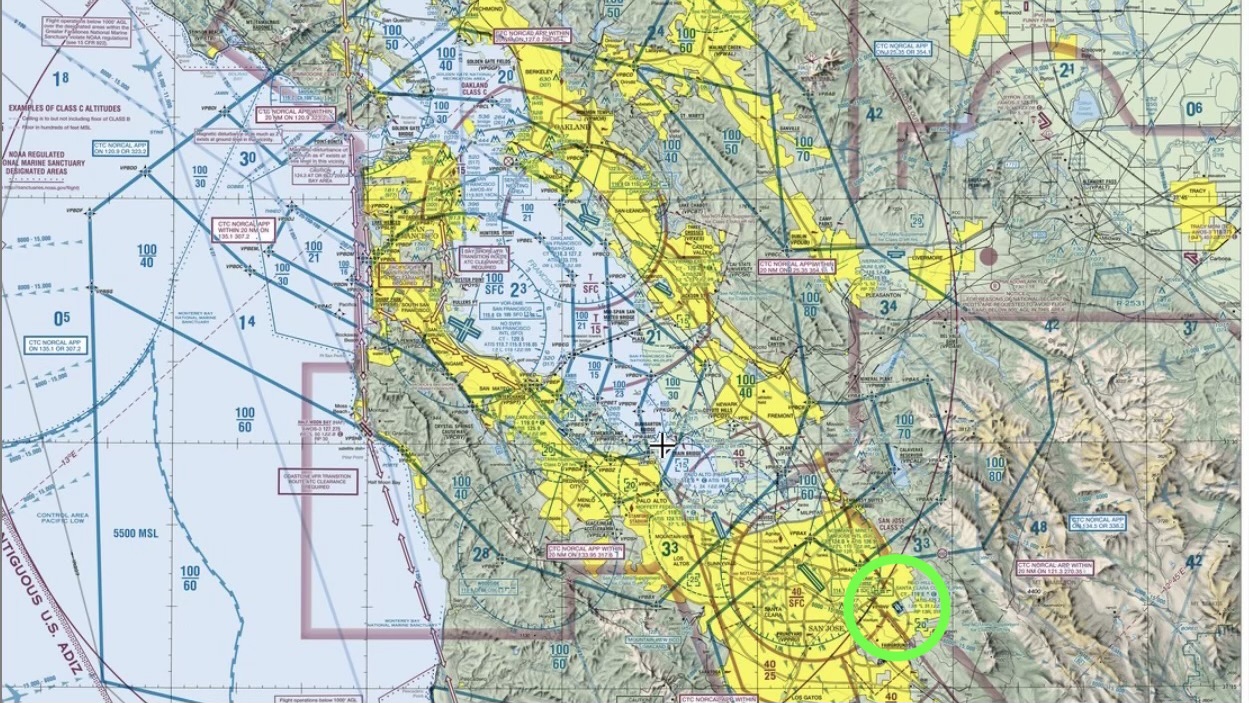
Location: Your airfield or simulator facility. (Limited to south San Francisco Bay Area.)
Additional Data Collection:
Longer sessions are great for analyzing scan endurance and workload management during cross-country flights or multiple instrument approaches.
The Technology
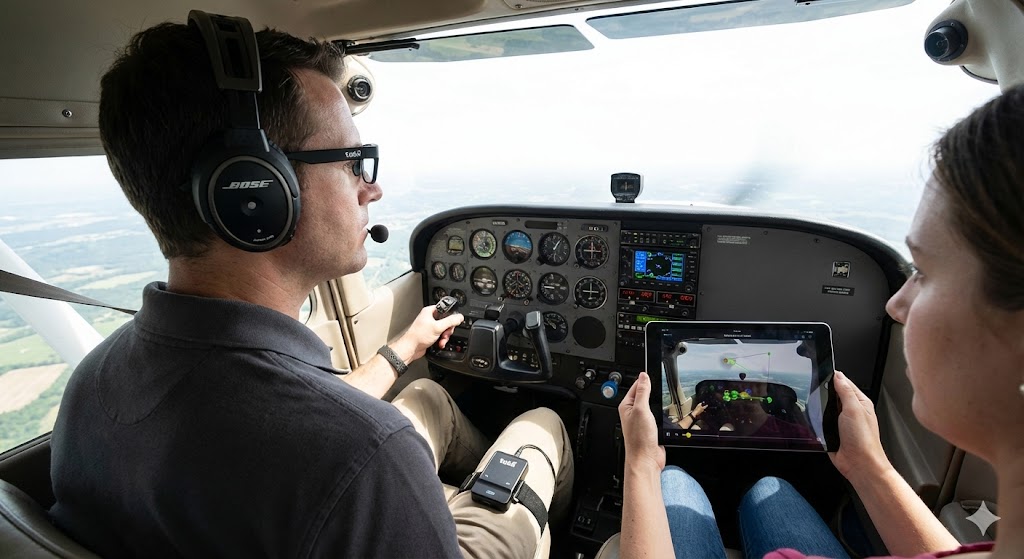
Unobtrusive Design: Looks and feels like safety glasses; does not block peripheral vision.
High Definition: 1440p wide-angle camera captures the full avionics suite.
Precision: 120Hz eye tracking detects even rapid saccades (quick eye movements).
Calibration-Free: saves time in the cockpit.
Slippage Compensation: headset movement won't ruin the data.
Dark Pupil Tracking: works in varying cockpit lighting conditions.
Corrective Lenses: available for common prescriptions (-6.0 to +3 diopters). Advanced notice may be required.
Benefits & Research
Benefits
Objective Feedback: Instructors can guess where you are looking. Eye tracking proves it.
Rigorous Offline Analysis: Rather than a rushed conversation on the ramp, your data undergoes advanced processing and expert evaluation. You receive a link to annotated video that you can review as many times as you need.
Situational Awareness: Research shows that expert pilots spend less time dwelling on single instruments. We analyze your dwell time and fixation frequency to optimize your scan.
Stress & Workload: Pupil diameter changes can indicate cognitive overload before you even feel it.
Further reading:
Ellis, Kyle Kent Edward. Eye tracking metrics for workload estimation in flight deck operations. The University of Iowa, 2009.
Martinez-Marquez, Daniel, et al. "Application of eye tracking technology in aviation, maritime, and construction industries: A systematic review." Sensors 21.13 (2021): 4289.
Stephens, Chad L., et al. "Psychophysiological Research Methods to Assess Airline Flight Crew Resilient Performance in High-Fidelity Flight Simulation Scenarios." 22nd International Symposium on Aviation Psychology. 2023.
About Me
Jon Boley, PhD
I translate complex cognitive science into simple, actionable flying habits.
My research focuses on understanding people's abilities, limitations, and behaviors.
I have been a pilot for over 20 years and enjoy a wide variety of flying.
Location: San Jose, California (USA)